
A business website describes a Manchester accountancy firm. Its company profile lists London, the founder biography links to an old domain, and payroll appears only in a footer. Every page may be understandable on its own, yet together they leave basic questions unresolved. This fictional example illustrates the problem KnowledgePanel.io calls fragmented identity information: facts about one entity are spread across sources without clear agreement or connections.
What to do first
Start with one identity record containing the facts you want to publish and the source behind each fact. Resolve contradictions, describe relationships explicitly, then publish clear website content with matching structured data. Measure search and AI representation separately from completion of that work.
1. A structured identity is more than a name and a schema file
An entity is the particular person, organisation or other subject a page describes. A structured identity is our practical term for a connected record of that subject: its public name, official home, work or services, relevant relationships and supporting sources. It is a way to organise information, not an official registration that every AI platform recognises.
For a business, the record might connect its trading name, service pages, service area and founder. For a person, it might connect their professional biography, company role, published work and confirmed profiles. The business and founder remain separate entities even when their information belongs in the same workspace.
2. Attach a source to each meaningful fact
A source should support the statement beside it. A company About page may support a founder relationship, while a payroll page supports the scope of a service. Linking a homepage to every claim is less useful than identifying the page that actually contains the relevant information.
Keep owner-published information distinguishable from independent reporting. A customer-reviewed biography is not automatically independently verified. Record disagreements and unknowns rather than generating plausible replacements.
- Fact: monthly payroll for UK SMEs. Source: the published payroll service page.
- Relationship: a named person founded the company. Sources: the company biography and the person’s reviewed profile.
- Status: approved, awaiting review or conflicting.
- Freshness: when the source was checked, separate from when the record was edited.
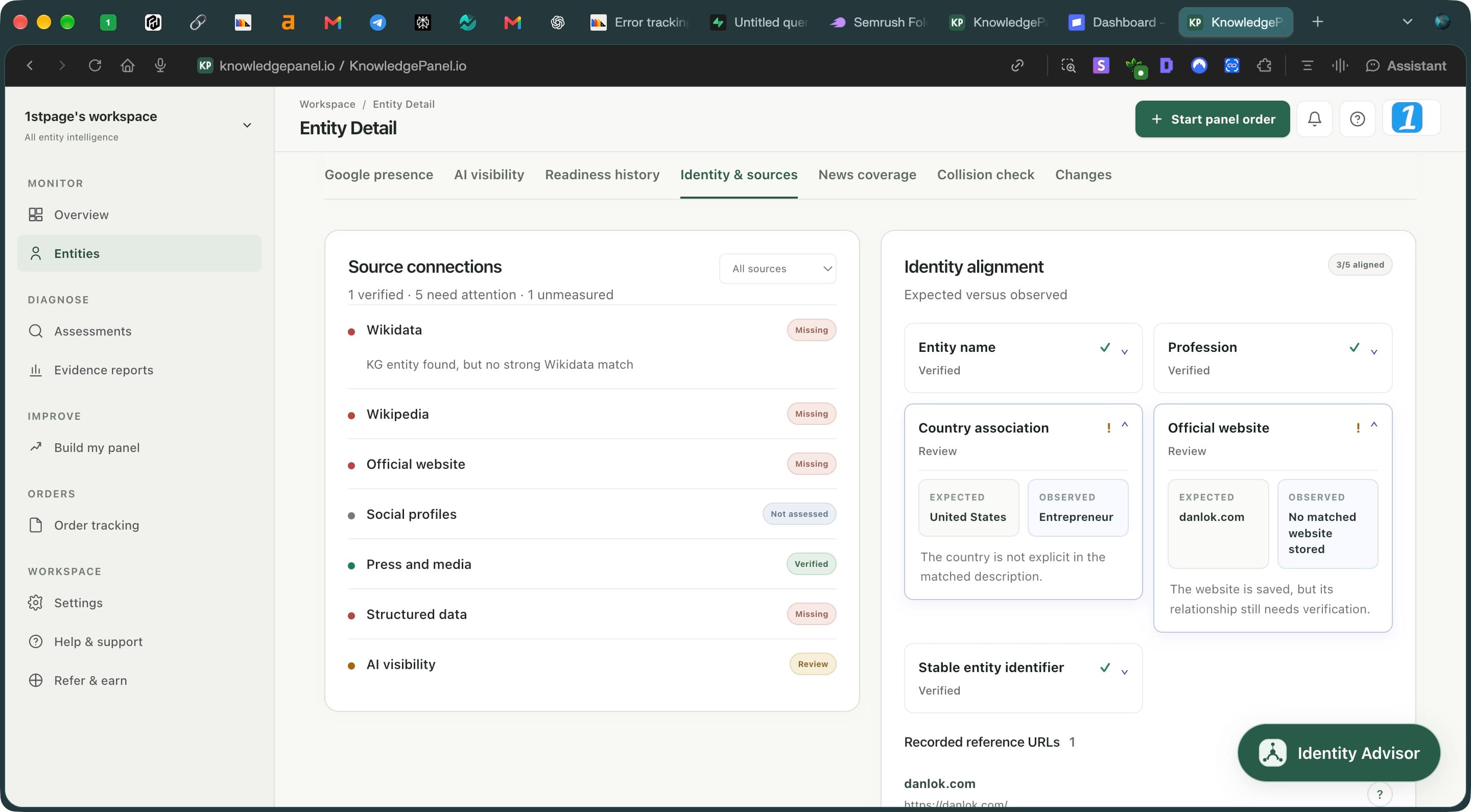
- Read the channel status. Not assessed means unmeasured, not absent.
- Expand a review item to compare expected details with observed evidence.
- Read the explanation before changing a fact or website connection.
3. Publish information where it can be discovered
A private dashboard helps you organise the work; it does not make those records available to external crawlers. Publish approved information on the official website, keep genuine profiles aligned and link the relevant pages together. The visible description should explain the same facts that appear in the structured data.
Google says organisation markup can help it understand and distinguish an organisation. Its AI search guidance also makes clear that special AI schema is not required. We therefore treat markup as one part of an accurate public presence, alongside accessible pages and useful content.
Google: Organisation structured data · Google: AI features and website optimisation
4. Use the report as a correction workflow
KnowledgePanel.io’s report brings together a saved assessment baseline, evidence records and implementation checks where those records are available. The score describes an assessment; it does not replace the facts and source links underneath it. An unassessed signal means there is no assessment, not that the person or business lacks the information.
Work through a specific correction: find the conflicting location, approve the right service area, update the relevant pages, validate the implementation and save the published URLs. Only a fresh assessment or AI observation can show what changed afterwards. A completed task does not by itself establish greater visibility.
Explore the fictional business report · Explore the fictional personal profile
5. Measure representation and commercial outcomes separately
Ask whether answers identify the right subject, describe their services or work accurately, attribute relationships correctly and cite appropriate sources. Keep the question, product, model where available, date and full answer. Compare equivalent checks instead of selecting the most flattering response.
Then investigate the commercial outcome: relevant visitors, enquiries and conversions. A correct mention may be useful without producing a lead. A website citation may send traffic without recommending the business. Keeping these measures separate helps you decide whether identity maintenance is creating value.
Frequently asked questions
Does a structured identity guarantee recommendations?
No. It provides clearer information for systems to discover and interpret. Whether a platform retrieves it or recommends the subject remains a separate outcome.
Do I need a Wikipedia page?
No. Wikipedia eligibility is a separate matter. Begin with accurate official information and sources relevant to the subject.
Where does Pro fit?
Pro supports ongoing identity work with facts, evidence, prepared content, schema and monitoring. Customers review and publish their changes.
Find the fragmentation in your identity
Start with an audit of your public information, then review the facts and sources that need attention.
Run your identity check →