
An AI answer names your business but links to a directory, a publisher or somebody else’s website. You may wonder whether your SEO is failing, whether you need more mentions or whether a visibility score is hiding the problem. Before changing anything, separate recognition from citation. The answer can identify the right entity while choosing a different source for the question it was asked.
What to do first
Read the full answer and open its source links. Check whether it recognises the right business, whether the cited pages support the statements and whether your official website answers the question clearly. Treat a relevant independent source differently from a wrong or outdated one. Improve an evidenced information gap, then compare later equivalent observations; a mention alone does not prove recommendation, traffic or commercial impact.
1. Separate a mention, a website reference and a citation
A mention means the answer names the entity. It may be a useful recognition signal, but context matters. The answer could name you as an example, compare you with other companies or mention you while recommending someone else. Counting the name does not settle which of those occurred.
A website reference means the answer includes your domain or address in its text. A citation or source link gives the reader a destination to inspect. An answer can contain one without the other, and a clickable source may support only part of the response. Open the destination instead of assuming every brand mention sends visitors to you.
A recommendation is another judgement: the answer actively suggests the entity for the user’s need. A traffic outcome requires an actual visit, and a commercial outcome requires an enquiry or purchase. These distinctions keep a visibility discussion connected to what you want the reader to do.
Business owners are asking how to get cited in ChatGPT and Gemini, as a Reddit discussion illustrates. The question is useful; the advice in the comments is not a substitute for provider documentation or your own evidence. Begin by inspecting the answers relevant to your business.
2. Read the percentages with their sample and denominator
The captured KnowledgePanel.io example shows an 80% mention rate and 60% Official site cited across five returned answers. Those figures do not mean that 80% of all AI users see the entity or that 60% of searches deliver a website visit. They describe a small, dated report sample.
The current official-site measure can detect the domain in answer text or an official URL among returned sources. It is broader than a count of clickable citations alone. Inspect the question-level answer and sources to establish whether the observation contains a domain mention, a link or both. The label should never replace that check.
For a completed five-answer sample without answer errors, 80% recognition represents four recognised answers; a 60% official-site measure represents three answers with that detected signal. Do not apply this arithmetic blindly to partial runs: failed responses are excluded from usable-answer percentages.
Identity accuracy can use a different denominator: recognised answers with measured accuracy judgements. Likewise, fourteen cited domains describes the distinct domains represented in the sample, not fourteen independent fact checks. Inspect the relevant pages before deciding that a larger source count is better.
The screenshots use an existing Dan Lok example record captured on 7 October 2026. They explain the interface and sample; they do not imply endorsement, a customer relationship or complete coverage of every AI product.
Investigate incorrect AI business information
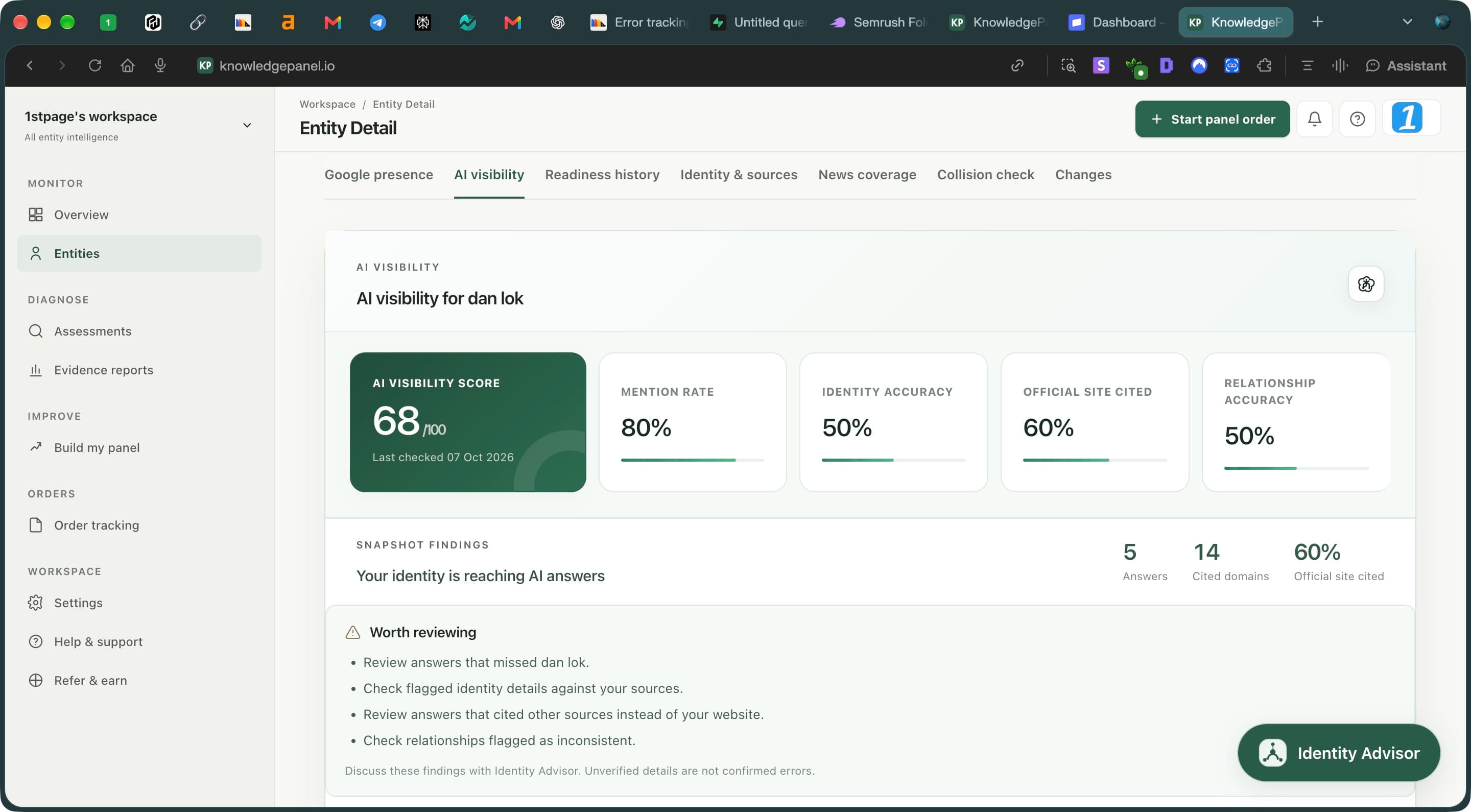
- Check the date. This is one measured baseline, not a universal AI score.
- Compare mentions, identity accuracy and website citations separately.
- Check sample size before drawing conclusions: five answers, fourteen domains.
3. Decide whether the other source is useful or wrong
Ask what the user’s question requires. A publisher page may provide a clear book credit. An organisation’s team page may corroborate a current role. Your own website may be the best destination for a service description or current contact information. A third-party source is not automatically a defect just because it is not your domain.
Evaluate the source on identity, relevance, support and currency. Does it describe your business? Does the cited passage answer the question? Is the information current enough for the claim? Can a reader find the underlying evidence rather than only a marketing summary?
When a source gets a material fact wrong, request a focused correction with a reliable reference. When it is accurate but your website lacks a useful page, improve your website. When it describes a namesake, investigate identity confusion. These three responses solve different problems and should not be collapsed into a campaign to collect more links.
Be cautious about the word independent. A hosted company biography, paid placement and original editorial reporting have different relationships to the subject. A domain count does not determine that relationship. Describe what the source actually provides rather than turning every external citation into an endorsement.
4. Make the right official page useful for the question
Choose a genuine information need to solve. If people ask whether you offer a service in a particular area, a page should explain the service and relevant coverage accurately. If they ask who founded the company, provide a clear company history and distinguish founders from current directors. Do not add every possible keyword to a generic biography.
Use specific, verifiable facts and appropriate context. A visitor should understand what you do, who the offer is for and any important limitations. Original examples, current product details and maintained documentation can make the page useful without inventing statistics or unsupported leadership claims.
Check the destination a person would reach. An outdated redirect, confusing sub-brand or thin landing page can make even a correct citation less useful. Align the page title, visible identity and navigation with the information being sought. If you operate several entities, keep their websites and relationships explicit.
You do not need to rewrite every paragraph into repetitive questions just for AI. Google’s official AI-search guidance rejects a special writing formula or mandatory tiny content chunks. Write for the reader’s task and use headings that help people find the answer. This is useful editorial work, not a promise that a particular model will select the page.
5. Check access for the actual service you are measuring
Ask your developer to check whether the relevant page is public and accessible to the intended search system. Keep your provider context clear: a check using OpenAI and web search is not an observation of Gemini, Google AI Mode or every personalised ChatGPT session. Test the product or integration you actually care about rather than generalising from one provider.
OpenAI’s publisher guidance identifies OAI-SearchBot for search discovery and GPTBot for potential training controls. Do not conflate those settings or assume you must allow training to be discoverable in search. Availability is a prerequisite to investigate, not a guarantee of selection.
Review access rules deliberately with whoever manages the site. The investigation should not weaken privacy or expose customer-only pages in pursuit of visibility. Public service information can be accessible while private account data remains protected. No headline score justifies publishing information that was never intended to be public.
6. Compare like-for-like observations after a meaningful change
Keep a baseline with the exact question, provider context, returned answer and source set. Record the public changes you made. A useful follow-up asks whether the corrected page is now referenced, whether the identity is clearer and whether the answer actually helps the reader more than before.
Do not compare unrelated prompt samples as though they were one experiment. An identity question and a local buying recommendation test different things. The current entity-oriented report is not a complete competitor-ranking study. If your business question needs category or location discovery research, acknowledge that additional work instead of implying the identity score covers it.
KnowledgePanel.io can compare matching captured answers and flag when whole-run comparisons are unavailable because coverage or measurement changed. Use that limitation as part of the interpretation. An unavailable overall difference is more honest than a precise number built from incompatible observations.
Avoid repeated checks solely to obtain a favourable screenshot. Use your available allowance after substantive changes, retain the previous result and report mixed outcomes. An official page can improve while the sampled answer still cites another relevant source.
Investigate incorrect AI business information · Fix identity gaps in your online presence
7. Connect visibility work to actual visitor outcomes
Use website analytics to investigate real referrals, then follow the visits through useful actions such as reading a service page or making an enquiry. Keep citation observations separate from those visits. A returned source link is an opportunity for a click, not evidence that anyone clicked it.
For Google search performance, Search Console supplies a different view of impressions, clicks and queries. It cannot validate every AI provider’s score. Combining distinct evidence is helpful when you preserve what each measure actually represents.
Your review can therefore say: the sampled answer recognised the business, used a more accurate service description and included a relevant official page; analytics recorded a specified number of referrals during the period. That is more actionable than claiming a higher composite score proves a revenue gain.
- Inspect answer context before counting a mention as a recommendation
- Open citations and verify the identity and supported claim
- Fix one evidenced source or content gap
- Compare equivalent dated observations
- Measure visits and enquiries separately
Frequently asked questions
Is an AI mention as valuable as a citation?
They describe different outcomes. A mention may show recognition; a relevant source link gives readers somewhere to inspect or visit. Judge each against the user’s question and your business goal, not a universal value ranking.
Why does the report count my official site when I cannot see a clickable citation?
The current official-site detection can count the domain in answer text or among returned sources. Open the captured answer and source list to distinguish those cases rather than assuming the metric always represents a clickable citation.
Does 60% official-site cited mean 60% of people visit my website?
No. It is an answer-sample measure. Visits and conversions require separate analytics evidence. Failed answers and different sample sizes also affect how a percentage should be interpreted.
Should I try to remove third-party citations?
Not simply because they are third-party. Accurate professional or editorial sources can help readers verify a fact. Correct factual errors and identity mismatches; do not treat legitimate independent coverage as something you control.
Will more structured data guarantee an AI citation?
No. Maintain accurate appropriate markup as part of your website work, but do not treat it as a citation switch. The relevant content, access, user question and provider context still need investigation.
Find the evidence behind your next correction
Review your entity’s public signals, inspect what needs attention and keep a baseline for your next assessment.
Review your entity →