
Someone asks an AI assistant about your business and receives an answer that sounds convincing but gets an important detail wrong. It names a service you do not offer, connects you with an unrelated company or sends people to an old website. Your first task is to identify the specific claim and the evidence behind it. Buying more content or running another scan before doing that can leave the actual problem untouched.
What to do first
Save the exact question, answer, date and source links. Check the disputed statement against reliable current information. Correct any inaccurate source you control, request a factual correction from relevant third parties and submit feedback through the AI product where appropriate. Then compare a later equivalent check. Updating a source can help, but it does not directly rewrite every model answer.
1. Identify the error before choosing a fix
Separate a false statement from an incomplete answer. If an assistant says you do not provide a service that your current service page clearly offers, there is a factual disagreement to investigate. If it says it could not find evidence of that service, the immediate problem may be discoverability or insufficient supporting information. Those are different diagnoses.
Also check that the answer describes your business rather than a namesake. Match the website, location, product category and organisation name. A familiar brand name alone does not settle identity. An answer about another company should not send you into rewriting accurate information on your own website.
Record the full interaction rather than a cropped sentence. The wording of the question may have supplied an assumption, an outdated location or the wrong company name. Keep any provider and model information that is available. A fresh conversation and a question grounded in the correct identity provide a more useful starting point than a leading request to confirm an error.
- Exact question and complete answer
- Date, product and available model information
- Disputed claim and its correct replacement
- Source URLs and the relevant passages
- Reason you believe each source describes the right business
2. Trace what the cited pages actually support
Open each relevant citation and look for the disputed fact. Does the page explicitly state it, merely mention a related topic or say nothing about it? A link attached to an answer is not proof that the page supports every sentence nearby. Read the underlying passage, including its date and context.
An outdated article may accurately describe a former service. A current directory may contain an error. A company biography may refer to a founder’s previous business rather than the one you operate now. Label these cases separately so your correction targets the actual source of confusion.
If no source supports the claim, record that result. You cannot reliably identify a model’s entire information history from its answer, and some answers may be unsupported. Avoid inventing a story about a particular database being responsible. Your evidence log should distinguish a confirmed source error from a suspected explanation.
A Reddit discussion about conflicting AI answers to a business-service question illustrates why people need this workflow. It is an example of the problem, not proof that one platform always uses a particular source. Start with what your own answer and citations show.
3. Use an AI visibility report to narrow the investigation
In KnowledgePanel.io, open your entity and choose AI visibility. Inspect the captured questions, returned answers and citations. Check the observation date and provider before comparing the report with something you saw elsewhere. An OpenAI-backed web-search observation does not establish what Gemini, another model or a personalised consumer conversation will say.
The example report captured on 7 October 2026 shows 68/100 overall, 80% mentions and 50% identity accuracy. These measures answer different questions. Mentions concern recognition in usable returned answers. Accuracy concerns recognised answers where an accuracy judgement was measured; unmeasured judgements are not a confirmed factual error.
A composite score is therefore a starting point for inspection. It should not override a clear answer-level mistake. If the business is recognised but a relationship is wrong, investigate that relationship rather than treating a respectable overall score as reassurance.
The screenshots use an existing Dan Lok example record to explain the interface. They do not imply endorsement, a customer relationship or an exhaustive assessment of his public identity. The first successful AI report is a baseline, not evidence that a campaign has improved anything.
Understand AI mentions and website citations
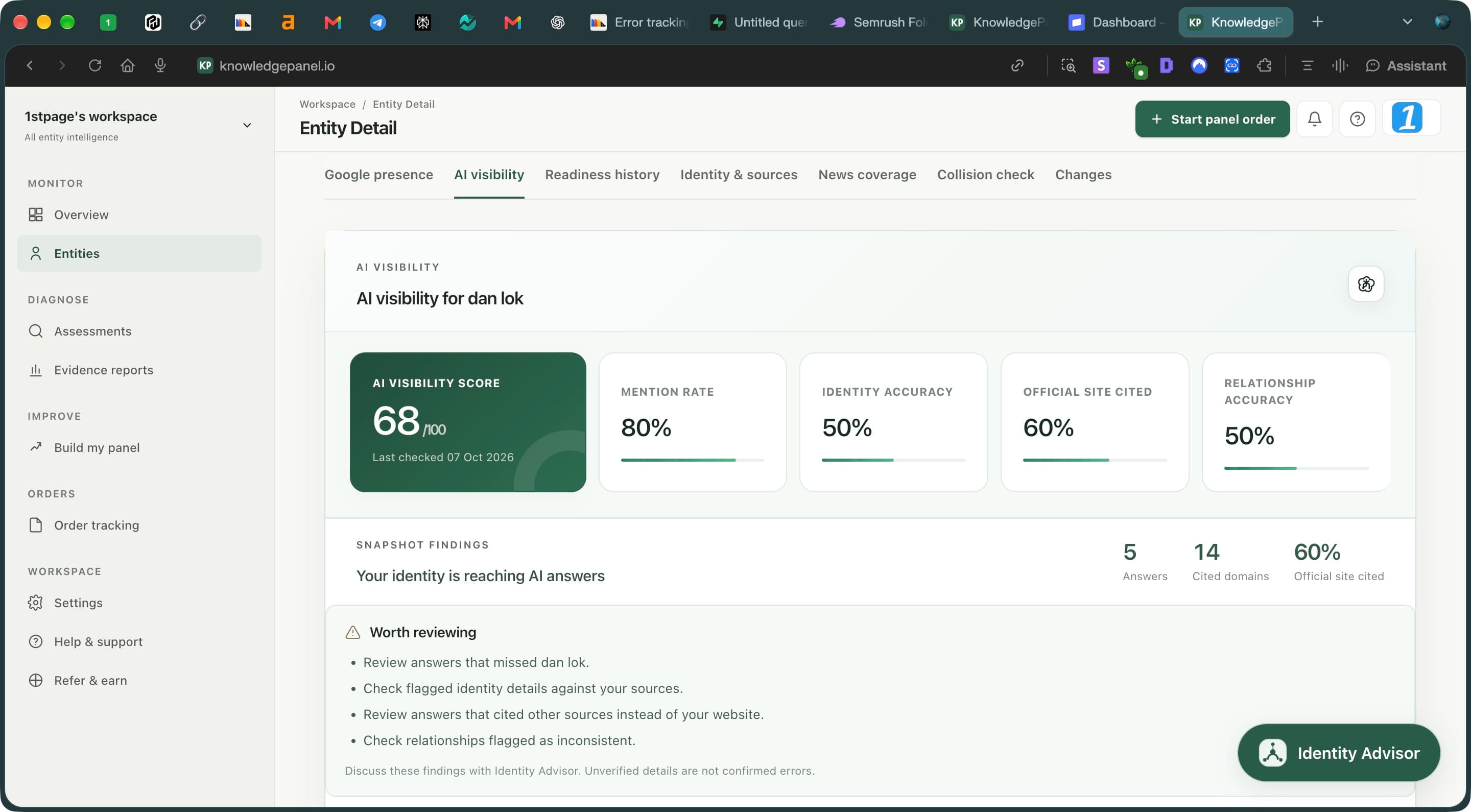
- Check the date. This is one measured baseline, not a universal AI score.
- Compare mentions, identity accuracy and website citations separately.
- Check sample size before drawing conclusions: five answers, fourteen domains.
4. Correct information on the sources you control
Choose the page that should answer the disputed question clearly. For a service, use the relevant service page. For a current role, use a maintained team or biography page. Make the correct fact visible and specific, and remove contradictory statements elsewhere on the same site. A homepage slogan is rarely enough to resolve a detailed product or eligibility question.
Suppose a fictional consultancy stopped offering residential design but an old services page still lists it. Update or retire that page appropriately, revise navigation and correct relevant profiles. Do not merely publish a new blog post saying the old information is wrong while leaving the original service claim in place.
Use an effective date when historical context matters. A company that changed its name or a professional who changed roles can explain both the previous and current facts. Erasing legitimate history may create new ambiguity; accurate context is more useful than pretending the earlier relationship never existed.
Keep a correction log with the URL, old wording, supported replacement, owner and publication date. This gives your team a concrete basis for follow-up and prevents repeated edits to pages that already say the right thing.
5. Request focused corrections from other publishers
When a third-party page is demonstrably wrong, contact the publisher through its ordinary correction process. Identify the exact statement and offer a reliable public reference. Make one clear factual request rather than asking for a promotional rewrite or insisting that an accurate independent article repeat your preferred marketing language.
A useful request says that a named page lists a retired service, provides the effective date and links to the current service information. It does not claim that correcting the page will guarantee a particular AI recommendation. The publisher controls its page, and the AI provider controls its output.
If a Google Knowledge Panel also contains the error, treat that as a separate correction route. Our wrong-website guide explains how to gather identity evidence and use Google’s feedback process. An AI answer, a Knowledge Panel and a Business Profile can contain related facts without sharing one editing interface.
6. Check discoverability without chasing AI shortcuts
Ask your developer whether the relevant page is publicly accessible, returns useful content and exposes the important facts without requiring a login. Investigate accidental access restrictions rather than assuming the answer is solely a writing problem. Different services have different crawlers and controls, so identify the system you are trying to make the page available to.
OpenAI’s publisher guidance distinguishes OAI-SearchBot access for search from GPTBot controls concerning potential training. Allowing search access is not a promise of a citation. Review the relevant settings deliberately instead of enabling every crawler because a generic checklist says to.
For Google’s AI search features, its official guidance says there is no special AI markup or llms.txt requirement. Focus on useful, accurate and accessible pages. A specialist file or a new schema block cannot substitute for correcting the misleading information a visitor can actually read.
OpenAI publisher discovery and crawler guidance · Google guidance for generative AI search
7. Measure the answer change, not just the score
Once corrections are public, save their dates and allow for discovery before an appropriate follow-up check. Compare the same question and provider context wherever possible. If coverage, models or questions differ, do not present the entire score difference as the effect of your work.
KnowledgePanel.io comparisons use matching provider, model and question information, and can withhold an overall change when the measurements are not comparable. Read that explanation. You may still inspect matched answer differences without pretending two different samples form a controlled experiment.
Your useful result is specific: the answer now identifies the correct business, removes an unsupported service claim or points to the right page. Separately monitor referral traffic and customer enquiries through your analytics. A more accurate sampled answer is worthwhile, but it is not proof that every customer will receive it.
Frequently asked questions
Can I edit what ChatGPT says about my business directly?
You cannot directly rewrite every generated answer. Correct relevant public sources, use available product feedback and inspect later equivalent observations. Preserve the original answer so you can demonstrate the specific factual problem.
Why does the AI answer still use old information after I updated my website?
The answer may rely on other pages, an older observation or information that has not been rediscovered. Inspect the returned sources before assuming the update failed. There is no fixed refresh timetable for every AI product.
Does 50% identity accuracy mean half of all AI answers about me are false?
No. It describes the measured accuracy judgements within that report’s relevant sampled answers. Review the denominator, unmeasured items and exact claims. It does not describe every answer across all providers.
What if the answer has citations but none support the claim?
Record the unsupported claim and the pages you checked. Treat the citation as an inspection route, not automatic verification. Use product feedback where available and improve any public information that genuinely needs correction.
Should I keep rechecking until I get a good answer?
No. That can consume checks and select an unusually favourable result. Correct a documented issue, then compare an appropriate later observation and retain the baseline, including answers that did not improve.
Find the evidence behind your next correction
Review your entity’s public signals, inspect what needs attention and keep a baseline for your next assessment.
Review your entity →